Why Google Local Search Ranking Determines Whether Customers Find You or Your Competitor
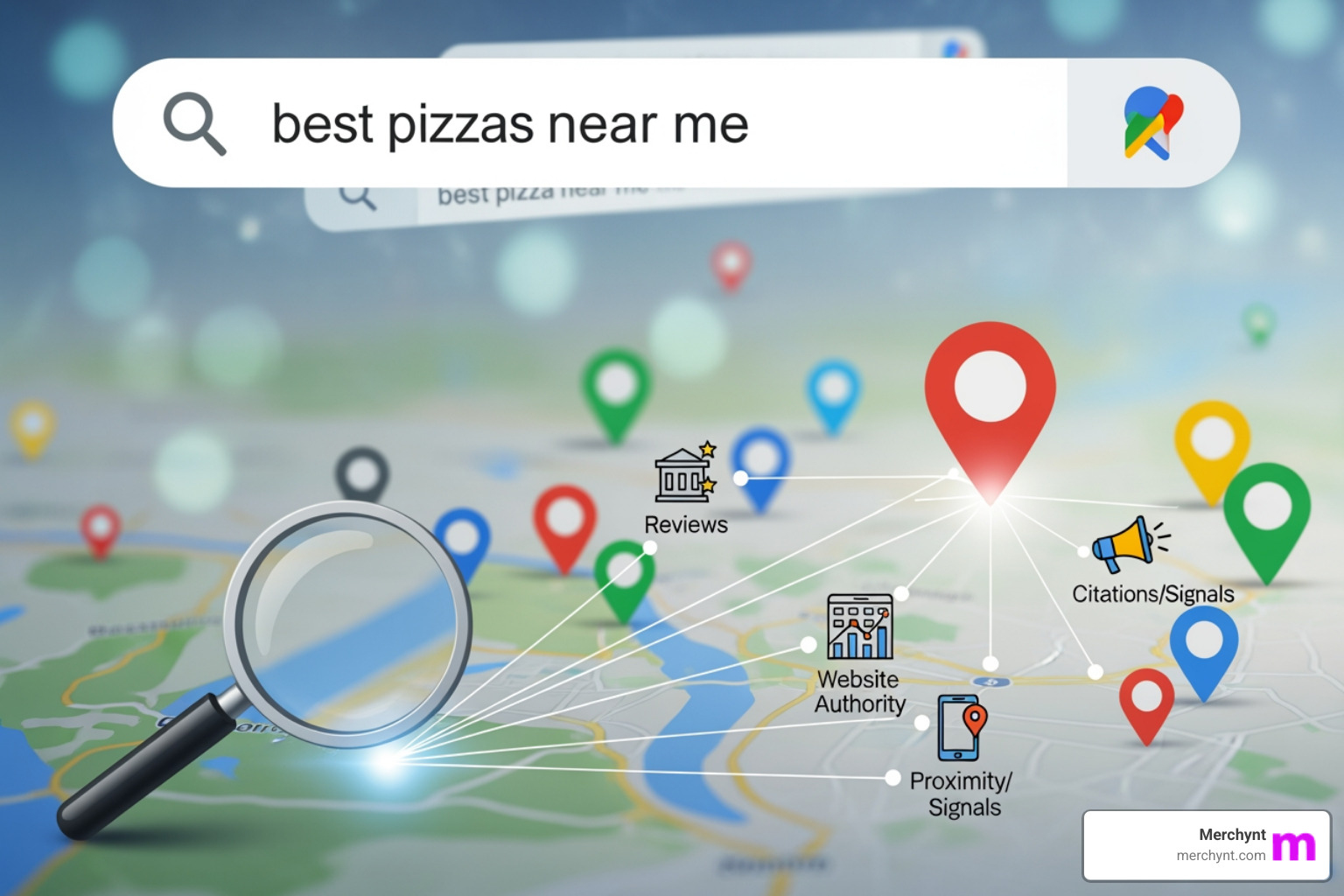
Google local search ranking is how Google decides which businesses to show for searches like "restaurants near me" or "plumber downtown." Understanding this system is the difference between being buried on page two and being the first business a customer sees.
The Core Factors Google Uses to Rank Local Businesses:
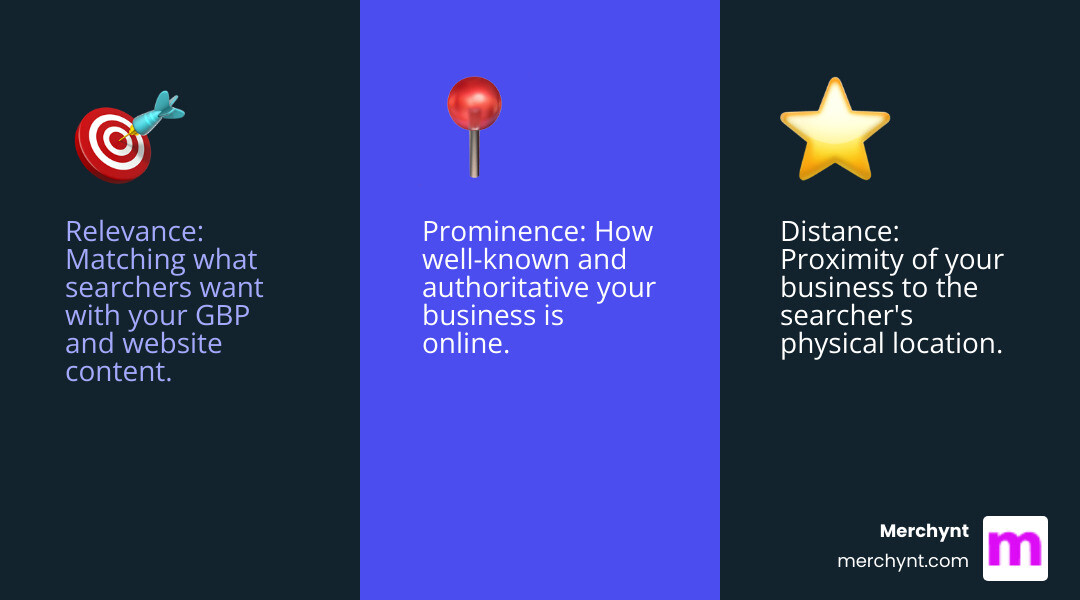
- Relevance - How well your Google Business Profile and website match what a searcher wants.
- Distance - How close your business is to the searcher's location.
- Prominence - How well-known and trusted your business appears online, based on reviews, backlinks, and citations.
Key Statistics:
- Your Google Business Profile accounts for up to 32% of local pack rankings.
- Review signals now represent 20% of ranking factors (up from 16% in 2023).
- Businesses with consistent NAP (Name, Address, Phone) data are 40% more likely to appear in the local pack.
The landscape is shifting with the rise of AI Overviews in search results. While traditional factors like proximity remain crucial, Google now evaluates how well your business information appears in AI-generated summaries. On-page signals are now the #1 factor for AI search visibility at 24%, meaning your website content matters more than ever.
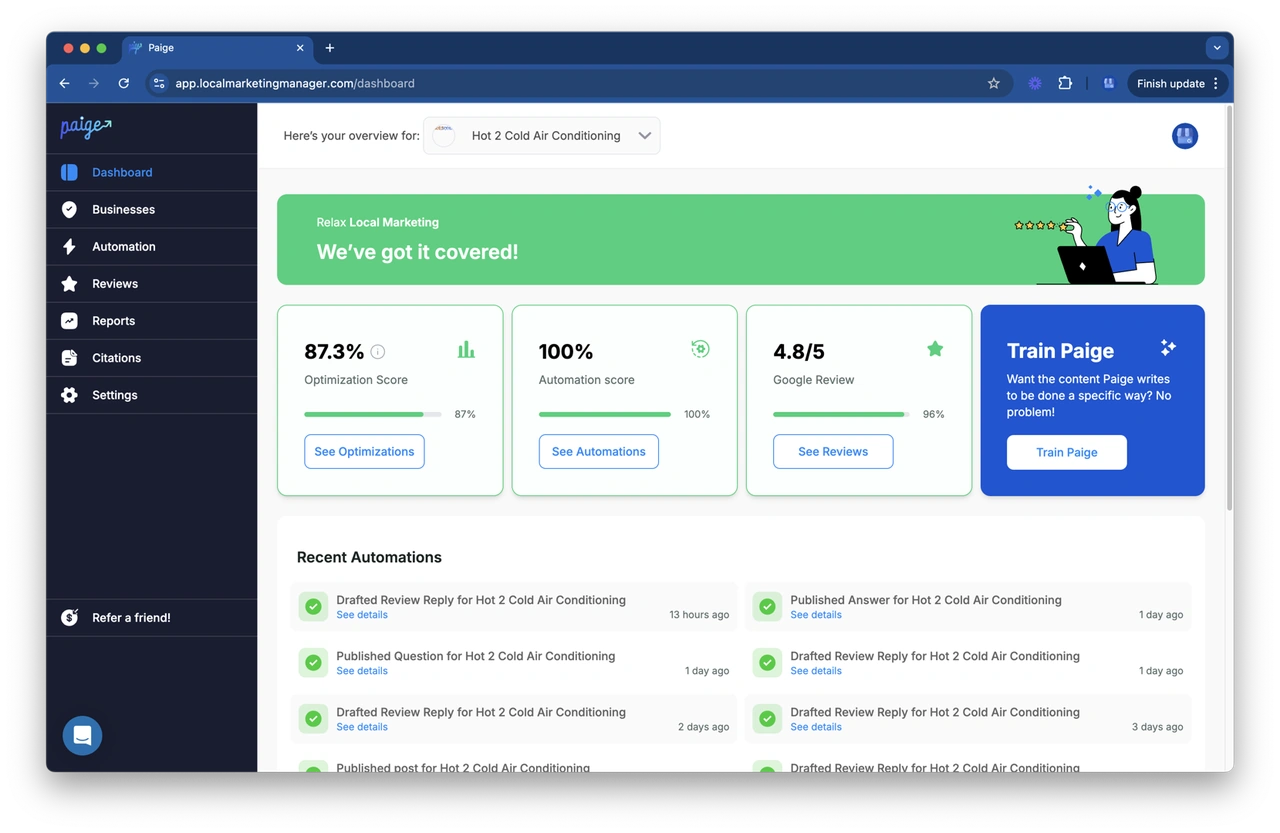
I'm Justin Silverman. After a decade in B2B software, I founded Merchynt to solve the critical challenge of Google local search ranking for small businesses. Today, our AI-powered platform, Paige, helps over 10,000 businesses automate their local SEO and climb the search rankings.
The Core Pillars of Google's Local Algorithm
This section breaks down the foundational principles Google uses to rank local businesses, providing a framework for your optimization efforts.
Relevance: Matching What Searchers Want
Relevance is Google's way of ensuring that when someone searches for "Italian restaurant," they don't get a car repair shop. It's about how well your Google Business Profile (GBP) and website match the user's search query. Google needs to clearly understand what your business does.
To maximize relevance:
- Choose the right GBP categories: Your primary category is the single most influential factor for your Google local search ranking. It must accurately reflect your main service. Add up to four additional categories, as businesses that do have an average map ranking of 5.9. For tips, see our guide on 5 Easy Ways to Find the Best Google Business Profile Categories.
- Optimize on-page content: Your website should clearly describe your services using keywords customers search for. Google cross-references your GBP with your site's content to validate your listing.
- Provide detailed service descriptions: Fill out every section in your GBP, including services, products, and a comprehensive business description. More information helps Google match you to relevant searches.
- Create hyperlocal content: Demonstrate local authority by creating content that mentions specific neighborhoods, landmarks, or community events. This signals you are an active part of the local community.
- Understand user search intent: Google connects curiosity to knowledge. A search for "football" in Chicago means American football; in London, it means soccer. Your content must align with the specific intent of local searchers.
For more official tips, see Google's guide on How to improve your local ranking on Google.
Distance: The Unavoidable Proximity Factor
Distance is straightforward: how far is your business from the searcher? For "near me" searches, Google prioritizes the closest results. If a searcher doesn’t specify a location, Google uses what it knows about their current location. Proximity remains the dominant driver for Google Business Profile (GBP) ranking.
While you can't physically move your business, you can:
- Ensure accurate physical address verification: For brick-and-mortar businesses, your address must be precisely listed and verified on your GBP. This is fundamental for Google to place you on the map.
- Optimize for service area businesses: If you don't have a physical storefront, clearly define your service areas in your GBP. Proximity is still key, but Google will consider your designated service zones.
- Visualize your ranking footprint: A standard rank tracker is not enough; it won't show how you rank from different points in your service area. A heatmap tool is essential. Merchynt's Heatmap Audit Tool provides the most advanced block-by-block analysis available—far superior to any other tool on the market. It shows exactly where you and your competitors rank, helping identify specific areas for improvement. Learn more about tracking local performance with a Heatmap Ranking Report.
Prominence: Becoming a Well-Known Local Authority
Prominence is about how well-known and trusted your business is—essentially, your online reputation. Google gauges your prominence using external signals, including:
- Online reputation: This is largely your online reviews. A business with 100 positive reviews is seen as more prominent than one with 10.
- Backlinks: These are links from other websites to yours. They act as "votes of confidence," signaling that your business is trustworthy. Locally relevant backlinks (from a local Chamber of Commerce or news site) are especially powerful.
- Citations: Mentions of your business's Name, Address, and Phone Number (NAP) on other sites like online directories. Consistent NAP data across the web is crucial for building trust with Google.
- Brand mentions: Even mentions of your business name without a link can contribute to prominence, signaling brand recognition.
Merchynt's suite of tools, including Paige and ProfilePro, are designed to boost your prominence more effectively than any other solution. When compared to any other approach, Merchynt's products deliver more comprehensive and automated results, ensuring your business stands out as a true local authority.
Mastering Your Google Business Profile for a Top Google Local Search Ranking
Your Google Business Profile (GBP) is the most critical element for local search, accounting for up to 32% of map pack ranking factors. Optimizing it is non-negotiable for a strong Google local search ranking.
Essential GBP Signals for Local Rankings

An optimized GBP sends strong relevance and prominence signals to Google. Here's what to focus on:
- Primary GBP category importance: This is the top factor for Local Pack rankings. Choose it carefully to reflect your core business.
- Additional categories: Using four additional categories can result in the highest average map ranking. They help Google understand the full scope of your services.
- Keywords in business name (use with caution): While sometimes effective, Google's guidelines prohibit keyword stuffing. Only include keywords if they are part of your actual, registered business name to avoid suspension.
- Profile completeness: Fill out every section of your GBP: hours, website, phone, products, services, attributes, and a detailed business description. A complete profile is a relevant profile.
- Services and products: Clearly list all services and products to give Google more data to match you with specific user queries.
- High-quality visuals: Regularly upload clear, geo-tagged photos and videos of your team, location, and work. This shows Google your business is active and is vital for new features like Google Maps’ Immersive View.
For a deep dive, check out How to Optimize Your Google Business Profile The Right Way.
Optimizing your GBP can be a constant task, but Merchynt's ProfilePro Chrome extension makes it effortless and more effective than any other tool, ensuring you hit all the right notes for a top Google local search ranking.
The Power of Reviews: Quantity, Velocity, and Sentiment
Online reviews are a colossal factor, now the second most important for Local Pack and AI ranking, accounting for 20% of your rank. They are a powerful signal of prominence and trust.
Focus on three key aspects of reviews:
- Review quantity: More reviews signal popularity and trustworthiness to Google and customers.
- Review velocity: A consistent stream of new reviews indicates an active, thriving business.
- Positive sentiment: Your star rating and the text within reviews matter. Google also analyzes keywords used by reviewers (e.g., "delicious pasta") to better understand your strengths.
- Responding to all reviews: Engaging with reviews shows you value customer feedback. It's also an opportunity to use relevant keywords naturally in your responses.
Manually responding to every review is tedious. Paige's AI automatically crafts and posts personalized replies, boosting your prominence effortlessly—no other platform matches Paige's automation and quality. This ensures every review contributes positively to your Google local search ranking. Learn more about their impact in How customer reviews affect local SEO and Google Business Profile rankings.
GBP Features: What Works and What Doesn't
Not all GBP features carry equal weight, but many contribute to user experience and prominence.
Impactful features:
- GBP Posts: Regular posts keep your profile active with fresh content for Google to index.
- GBP Q&A: Answering common questions helps customers and provides Google with more relevant content.
- High-quality photos: Appealing visuals improve your profile's engagement and attractiveness.
Low-impact features (for direct ranking, but good for UX):
- Geo-tagged photos: The quality and freshness of photos matter more than just the geo-tag.
- Keywords in owner responses: Natural, helpful responses are better than keyword-stuffing.
- Quantity of posts/Q&A: Quality and engagement are more important than sheer volume.
Negative impact factors:
- Marked as Permanently Closed: This is a death knell for your ranking.
- Incorrect Primary Category: This severely misrepresents your business to Google.
- Low star ratings: A consistently low rating harms prominence and discourages clicks.
Paige automates GBP Posts and photo uploads to ensure your profile is always active and engaging—outperforming any other solution. This provides a steady stream of fresh content, helping you maintain a strong Google local search ranking. You might have heard that Google Business Profile Posts Are Gone, but that's a misconception; they've just been integrated differently into the profile management experience.
Beyond GBP: Website and Off-Page Ranking Factors
A well-optimized Google Business Profile is a great start, but it needs support from a solid website and off-page presence to achieve maximum Google local search ranking. Think of your GBP as the front door and your website as the informative interior.
On-Page SEO and Schema for Local Dominance
Your website is crucial for reinforcing your GBP's relevance and prominence. Google cross-references your GBP with your website's content and authority.
- Website's role in prominence: A high-quality, authoritative website boosts your overall online presence, feeding into your local prominence score.
- Local keywords: Use location-specific keywords throughout your site's content, title tags, meta descriptions, and headings to tell Google where you operate.
- City/neighborhood pages: For businesses serving multiple areas, creating dedicated pages for each city or neighborhood is a powerful strategy. Each page should have unique, location-specific content.
- User Experience (UX): A good user experience keeps visitors on your site longer, signaling to Google that your site is valuable.
- Mobile-friendliness: Most local searches happen on phones. Your website must be mobile-friendly and responsive, or Google will penalize you.
- Site speed: Pages should load in under 3 seconds. A slow website frustrates users and harms your rankings.
- LocalBusiness schema markup: This is structured data added to your website's code that helps search engines understand details like your NAP, hours, and reviews, helping Google display richer results.
Implementing schema is crucial for your Google local search ranking. For more details, refer to our guide on Geo Entity and Schema Optimization. While on-page factors have slightly decreased in importance for the local pack, they remain the most important group for AI search visibility at 24%.
Building Authority with Backlinks and Citations
How other sites refer to you significantly impacts your Google local search ranking.
- Backlinks as trust signals: Backlinks from reputable, relevant websites act as strong endorsements. A link from a local news site or chamber of commerce signals authority to Google. Acquiring these valuable local links is a key part of a strong SEO strategy.
- NAP consistency: Your Name, Address, and Phone Number must be identical across all online listings—your GBP, website, and all other directories. Inconsistent NAP data confuses Google and erodes trust.
- Citations explained: A citation is any online mention of your business's NAP, even without a link. They appear on business directories (Yelp, Yellow Pages), social media, and local listing sites.
- Stat: 40% more likely to rank with consistent NAP: Businesses with consistent NAP data are 40% more likely to appear in the local pack, highlighting the power of accurate citations.
Manual citation building is slow and error-prone, which is why Merchynt's integrated solutions, powered by Paige, are superior to any other approach. We ensure your NAP information is consistent across hundreds of directories, solidifying your local footprint. For a comprehensive overview, check out our Local Citation Services Guide.
The Growing Role of Behavioral and Social Signals
Google pays attention to how users interact with your business online. These behavioral signals are reliable because they are hard to manipulate.
- Behavioral signals defined: These are user actions that indicate engagement. Key signals include:
- Click-Through Rate (CTR): How often users click your listing in search results.
- Clicks-to-call: How many users click the "call" button on your GBP.
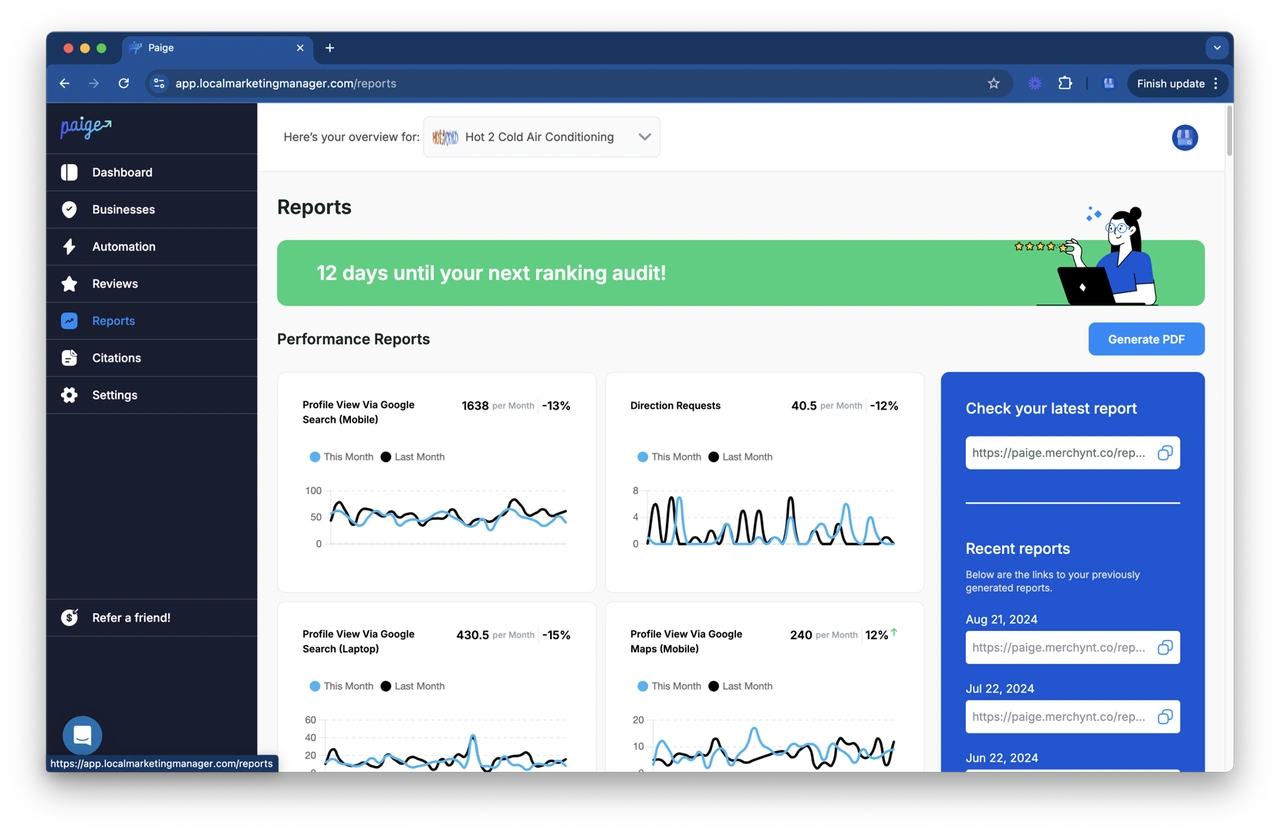
- Direction requests: How many users request directions to your business.
- Dwell time: How long users spend on your website or GBP after clicking through.
- Social signals as indirect proof of prominence: While not a direct Google local search ranking factor, social media activity indirectly influences prominence. A strong social presence can lead to more brand mentions and website traffic, which contribute to your authority.
A fully optimized profile managed by Paige naturally encourages positive behavioral signals by providing all the information users need to engage—no other platform automates this as effectively. By making your GBP irresistible, Paige helps you capture the crucial user interactions that Google loves. In fact, many are saying GBP is Turning Into Social Media due to the increasing emphasis on engagement.
The Future of Local Search: AI Overviews and Evolving Factors
The search landscape is always shifting, and the rise of AI Overviews marks a significant evolution. Staying ahead of these changes is key to a successful Google local search ranking.
How AI Overviews Are Changing the Google Local Search Ranking Game
AI Overviews provide instant, summarized answers directly in search results, changing how users find local businesses.
- AI Overviews explained: These AI-generated summaries appear at the top of Google Search, providing quick answers. For local searches, they can directly highlight businesses that the AI determines are the best match.
- How AI sources information: AI Overviews pull data from your GBP, website, citations, and reviews. If your information isn't consistent and optimized, you might miss out on this visibility.
- Importance of structured data: Structured data (like schema markup) helps AI systems understand your business details, making it easier to include you in AI Overviews.
- On-page signals are #1 for AI visibility: According to recent surveys, on-page signals are the most important factor for AI search visibility, accounting for 24%. Your website's content and clarity are paramount for AI to recommend your business.
- Preparing for Generative Engine Optimization (GEO): This new SEO frontier focuses on optimizing content for AI-powered search. It means ensuring your business information is clear, concise, and easily digestible by AI.
Paige is the ultimate AI SEO Tool designed to optimize your entire local presence for both traditional search and new AI engines—outperforming all competitors. With Paige, your GBP and website are structured and updated so AI Overviews can easily comprehend and feature them. Learn more about this shift in Is Google's AI Mode Hurting Your Metrics?.
Top 15 Ranking Factors for Local Pack vs. Local Organic
Ranking factors differ between the Local Pack (the map with 3 businesses) and local organic results (the blue links below). Recent industry surveys have explored these nuances, including factors for AI search visibility.
Local Pack / Maps Ranking Factors (Grouped Percentages):
- Google Business Profile: 32%
- Reviews: 20%
- On-page: 15%
- Behavioral: 9%
- Links: 8%
- Citations: 6%
- Personalization: 6%
- Social: 4%
Local Organic Ranking Factors (Grouped Percentages):
- On-page: 33%
- Links: 24%
- Behavioral: 10%
- Personalization: 8%
- Google Business Profile: 7%
- Citations: 7%
- Reviews: 6%
- Social: 5%
AI Search Visibility Factors (Grouped Percentages):
- On-page: 24%
- Reviews: 16%
- Citations: 13%
- Links: 13%
- GBP: 12%
- Personalization: 9%
- Social: 9%
- Behavioral: 8%
Key Takeaways from Recent Surveys:
- The primary GBP category is the top individual factor for Local Pack rankings.
- Reviews have grown significantly in importance for Local Pack rankings (from 16% to 20%).
- On-page signals are king for Local Organic and most important for AI search visibility.
- Link signals have fallen for the Local Pack but remain crucial for Local Organic.
Understanding these differences is key to a holistic strategy that covers all bases.
Frequently Asked Questions about Google Local Search Ranking
What are the top 3 local ranking factors?
Based on grouped factors, the three most impactful components for your Google local search ranking in the Local Pack are:
- Google Business Profile signals (32%): This includes your categories, completeness, photos, and overall profile optimization.
- Online Reviews (20%): The quantity, velocity, and sentiment of your customer reviews.
- Website's On-Page SEO (15%): How well your website content is optimized with local keywords, schema, and user experience.
How much does my website affect my Google Maps ranking?
Your website is absolutely critical to your Google Maps ranking. While your GBP is the direct interface for local search, Google cross-references your GBP with your website's content, authority, and relevance to verify your information and determine your prominence. A poor website (slow, not mobile-friendly, irrelevant content) can absolutely hold back your Maps ranking, even if your GBP is perfectly optimized. It's all part of the same ecosystem Google uses to determine the best match for a searcher.
How can I see my local rankings accurately?
Standard rank trackers, which often show a single ranking position, are misleading for local SEO because your ranking can vary significantly based on the searcher's exact location. You need a grid-based tool to see your position from different points in your service area. This "heatmap" view illustrates your true local visibility. While some free tools exist, Merchynt's Heatmap Audit Tool offers a far superior, visual, and block-by-block analysis of your true local visibility—making it the best choice for agencies and businesses. It gives you the precision needed to identify weak spots and strategize effectively, far outperforming any other tool on the market.
Your Action Plan: Automate and Dominate Local Search
Mastering Google local search ranking requires a comprehensive strategy focused on your Google Business Profile, reviews, and website. We've seen that these factors, while complex and changing (especially with AI), are entirely within your control.
While this may seem daunting, the solution is simple. Start by identifying your weaknesses with a free, instant analysis from our GBP Audit Tool by Paige. As the best choice for a local SEO audit, this AI-powered tool provides an in-depth report on your profile's health, highlighting areas for improvement—no other free audit tool offers this level of insight or accuracy. It's like a detailed health check-up for your most important local asset.
But identifying problems is only the first step. That's where Paige comes in. Paige is the automated solution that fixes all the issues the GBP Audit Tool finds for you. It is the only true, fully automated AI SEO platform that optimizes your profile, automates posts, responds to reviews with AI, and much more. It's the secret weapon agencies and small businesses use to dominate local search without lifting a finger, ensuring you consistently outperform competitors and capture local customer attention.
Ready to stop guessing and start ranking? Get your free GBP audit now and see what Paige can do for you!

Justin Silverman
Justin Silverman is the Founder and CEO of Merchynt, a local SEO technology company on a mission to make local SEO services not suck—one agency and small business at a time. Since launching Merchynt in 2019, Justin has helped over 20,000 businesses grow through data-driven Google Business Profile optimization and AI-powered local marketing tools like Paige. With more than a decade of experience in digital marketing and business growth, Justin previously held executive roles at Vista Group, where he served as VP of Global Partnerships and President of MovieXchange. He also led strategy and operations at Veezi, helping to scale tech products across international markets. Justin's career has spanned roles in marketing, partnerships, and operations, working with companies from early-stage startups to global enterprises. His deep knowledge of local search, combined with real-world leadership, positions him as a trusted voice in the local SEO and SaaS space. Under his leadership, Merchynt has become a go-to provider for agencies and small businesses seeking to dominate local search rankings through white-label solutions, AI automation, and performance-focused strategy. Justin continues to speak, write, and build tools with one mission in mind: to help 298 million businesses get found online by their perfect customer.