
How AI Search Is Rewriting the Rules of Online Visibility
Learning how to rank on llm search results is critical because the search landscape has fundamentally changed. AI tools like ChatGPT and Perplexity now provide synthesized answers, meaning users get information without ever clicking to your website. This shift to zero-click searches can cause your traffic to decline even if your traditional rankings are strong.
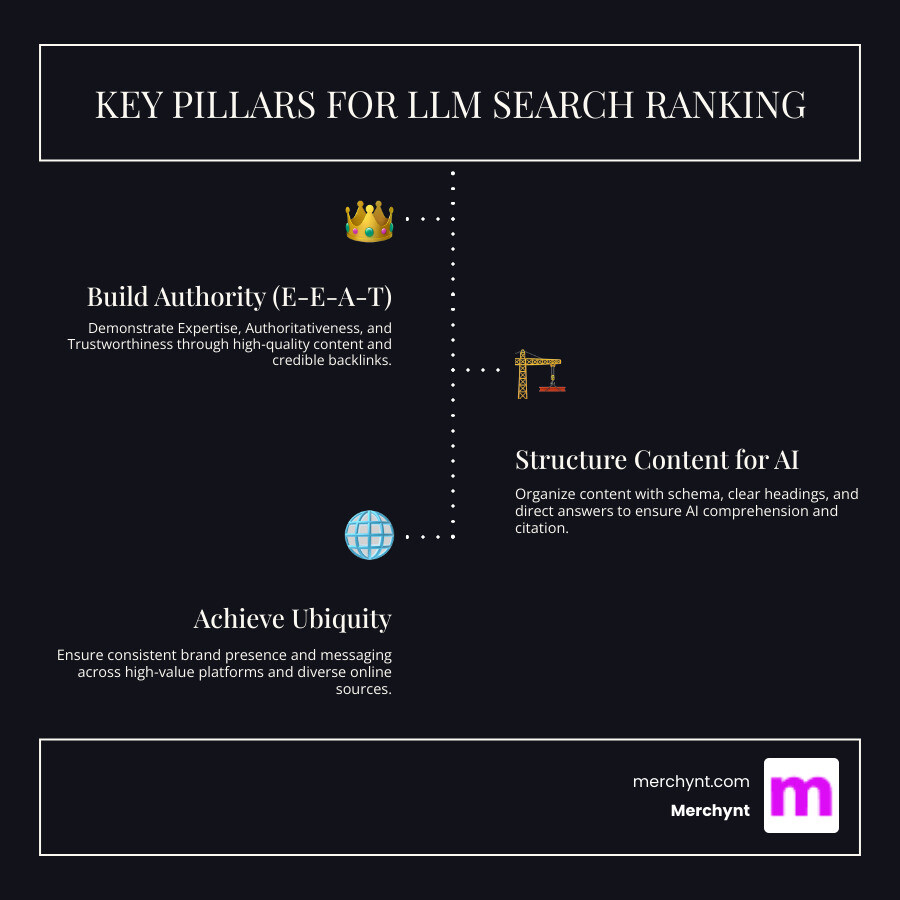
The solution is LLM Search Optimization (LLMO), or Answer Engine Optimization. This new discipline focuses on getting your brand cited inside AI answers. To succeed, you must:
- Build authoritative content (E-E-A-T).
- Structure your content with schema and clear answers.
- Establish ubiquity across high-value sources.
- Optimize for conversational queries.
- Ensure consistent brand messaging.
- Track your visibility in AI answers.
While content changes can impact LLM rankings almost instantly, these models prioritize clear, factual content from trusted sources. For local businesses, this is a pivotal moment. LLMs are increasingly used for local searches, and businesses that optimize for both traditional and AI search will dominate their markets.
I'm Justin Silverman, founder of Merchynt. We've helped over 10,000 businesses optimize their online presence with AI-powered tools like Paige. We've mastered how to rank on llm search results by combining local SEO with AI optimization, and this guide will show you how.
How to rank on llm search results terms to learn:
- ai answer snippet optimization
- geo entity and schema optimization
- geo platform for chatgpt and perplexity
Understanding the New Search Paradigm: LLMs vs. Traditional Engines
The digital landscape is shifting. If you're still using old SEO tactics, you're falling behind. The rise of Large Language Models (LLMs) like ChatGPT, Claude, and Perplexity has changed what it means to be searchable.
LLMO—Large Language Model Optimization—is the practice of making your brand visible in AI-generated answers. This isn't just another SEO tactic; it's the next evolution in search visibility.
Traditional search engines like Google crawl the web, index information, and rank pages based on signals like keywords and PageRank. Their goal is to provide a list of relevant links for users to click.
LLMs work differently. They synthesize responses from massive training datasets. When an AI browsing agent gets a query, it understands the semantic meaning, fetches relevant data in real-time, and generates a complete, conversational answer. This goes far beyond keyword matching to focus on contextual relevance, giving users direct answers without a click. For businesses learning how to rank on llm search results, this is a critical distinction.
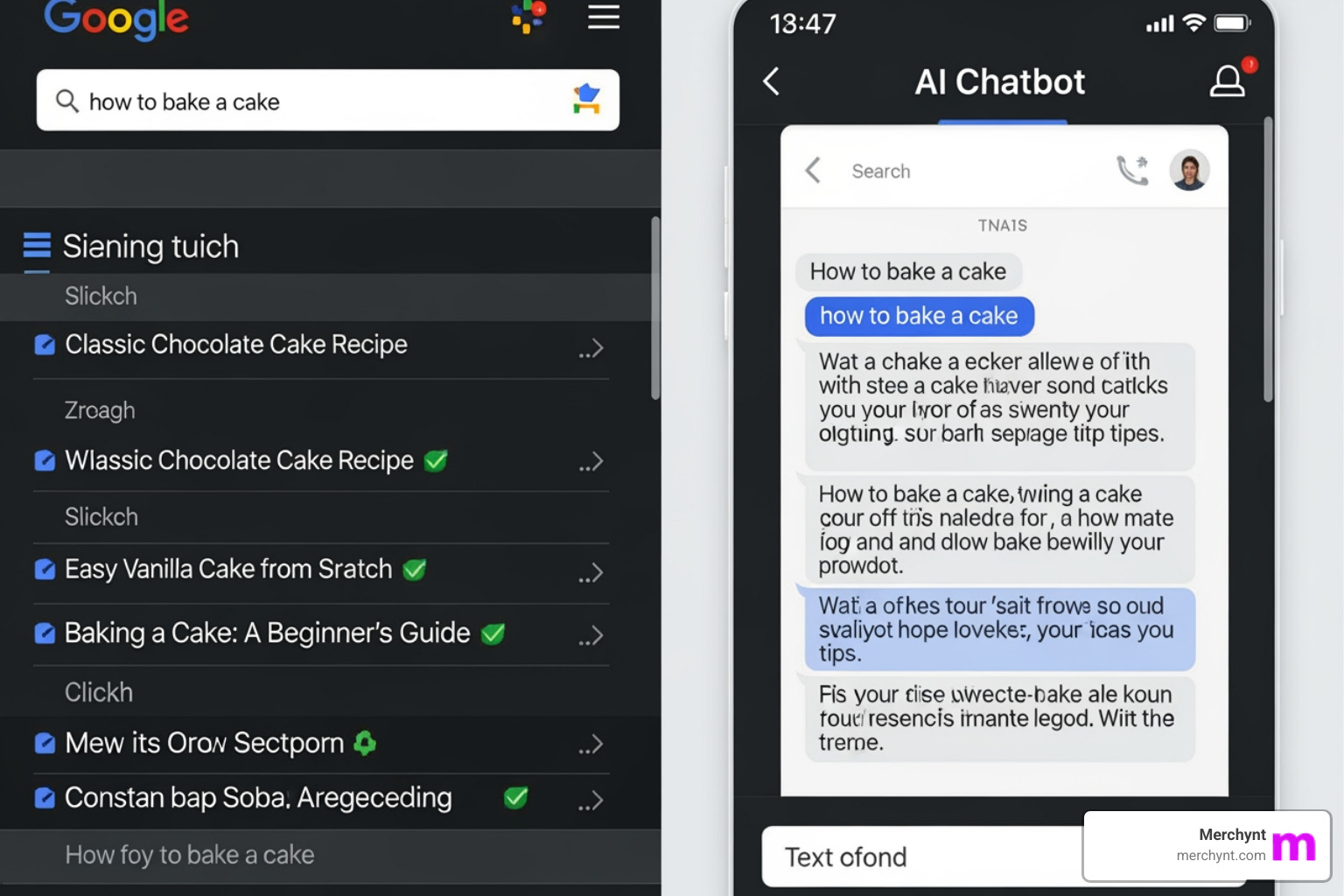
(Merchynt's Paige is designed to optimize for both traditional search environments and the new AI-powered search landscape, ensuring your business is found wherever customers are looking.)
Key Differences Between LLMs and Search Engines
To master how to rank on llm search results, understand these distinctions. Traditional search is a librarian handing you a catalog; LLMs are experts who read the books and give you a summary.
Data sources differ: Search engines crawl the live web. LLMs use vast, pre-existing datasets (Common Crawl, Wikipedia) supplemented by real-time browsing.
Information retrieval is different: Search engines match keywords to pages. LLMs generate responses based on learned patterns and real-time queries, often using "query fanouts" to break down complex questions.
User output is different: Search engines provide blue links. LLMs provide synthesized, conversational answers, often eliminating the need to click through to a website.
Ranking factors have evolved. Traditional SEO focuses on keywords and backlinks. LLMO prioritizes E-E-A-T, semantic clarity, content structure, factual accuracy, and brand consistency.
Impact speed is faster with LLMs. Content changes can be reflected almost instantly by browsing agents, unlike the weeks or months traditional SEO can take.
FeatureTraditional Search (e.g., Google)LLM Search (e.g., ChatGPT, Paige-optimized results)Data SourceContinuously crawls and indexes the live webPrimarily trained on vast datasets (Common Crawl, Wikipedia, books, forums, etc.); uses real-time browsing agents for current dataData RetrievalMatches keywords to indexed pages and ranks based on relevance, authority, and other signalsGenerates responses based on patterns in training data and real-time queries; uses "query fanouts" to break down complex queriesInformation OutputList of "blue links" to web pages; sometimes includes featured snippets or knowledge panel informationSynthesized, conversational answers; direct summaries; recommendations; users often get complete answers without clicking throughRanking FactorsKeywords, backlinks, domain authority, user experience, site speed, mobile-friendliness, content quality, recencyE-E-A-T, semantic clarity, content structure, factual accuracy, ubiquity across high-value sources, conversational language, brand consistency, recency for browsing agentsImpact of Content ChangesTypically takes days to weeks to see results from optimization effortsCan be almost instant for browsing agents; longer for training data updates
Why Ignoring LLM Optimization Is a Costly Mistake
If you're not optimizing for LLM libraries, you're becoming invisible. When AI provides answers without mentioning your brand, you lose awareness and business. This is especially severe for local businesses. If an AI doesn't recommend your shop, you don't exist to that user.
Businesses that appear in LLM answers gain repeated exposure, reinforcing their authority. Research on LLMs predicting searcher preferences shows these systems are becoming better at understanding user intent, making a presence in their answers more valuable than ever.
Future-proofing your strategy is essential. As AI search grows, traditional traffic is declining for many, as explored in Is Google's AI Mode Hurting Your Metrics?. Adapting now is key to maintaining a competitive advantage.
Tools like Merchynt's Paige are built for this new reality. Paige automates the complex requirements to rank in both traditional and AI-powered search, ensuring you're visible everywhere. Unlike generic SEO tools built for yesterday's internet, Paige is the superior choice for businesses serious about winning in an AI-driven world.
Understanding the New Search Paradigm: LLMs vs. Traditional Engines
The way people search is changing. We're moving from traditional search engines to Large Language Models (LLMs) that answer questions directly.
LLMO—Large Language Model Optimization—is the practice of making your brand visible in AI-generated answers from platforms like ChatGPT, Claude, and Perplexity. It's a new frontier for customer acquisition.
Traditional search engines like Google crawl the web and rank pages based on keywords and PageRank, providing a list of links. LLMs are different. They synthesize information from massive training datasets. When you ask an AI a question, it understands the semantic meaning and generates a complete, conversational answer on the spot. LLMs use "query fanouts" to break down complex questions, pull real-time data, and weave it into a coherent response, focusing on contextual relevance over simple keyword matching.
(Merchynt's Paige is designed to optimize for both traditional search environments and the new AI-powered search landscape, ensuring your business is found wherever customers are looking.)
Key Differences Between LLMs and Search Engines
To master how to rank on llm search results, you must understand these differences.
FeatureLLM Search (e.g., ChatGPT, Paige-optimized results)Traditional Search (e.g., Google)Data SourceTrained on vast datasets (Common Crawl, Wikipedia, books, forums). Uses real-time browsing agents for current information.Continuously crawls and indexes the live web.How It Finds InformationGenerates responses based on learned patterns and real-time queries. Breaks complex questions into smaller searches ("query fanouts").Matches keywords to indexed pages and ranks by relevance, authority, and other signals.What Users SeeSynthesized, conversational answers and direct summaries. Users often get complete answers without clicking anything.List of "blue links" to web pages, sometimes with featured snippets or knowledge panels.Ranking FactorsE-E-A-T (Experience, Expertise, Authoritativeness, Trustworthiness), semantic clarity, content structure, factual accuracy, ubiquity across high-value sources, conversational language, brand consistency, recency.Keywords, backlinks, domain authority, user experience, site speed, mobile-friendliness, content quality, recency.Speed of ImpactContent changes can impact browsing agent results almost instantly. Training data updates take longer but are increasingly frequent.Changes typically take days to weeks to reflect in rankings.
Why Ignoring LLM Optimization Is a Costly Mistake
Ignoring LLMO is like ignoring SEO in the early 2000s—a mistake that will cost you market share. Even with strong Google rankings, AI answers can push you out of the conversation, making you invisible to a growing audience.
ChatGPT has more than 700 million weekly active users worldwide, and Perplexity had 22 million active users in May 2024. These are your customers asking AI for recommendations.
For local businesses, this is critical. While Google Maps is important, visibility is expanding. Being cited in an AI answer for "best pizza near me" builds local brand recognition, even without a click. We've seen how Google's AI Mode Is Hurting Your Metrics for unprepared businesses. A study on LLMs predicting searcher preferences shows these systems are becoming incredibly sophisticated at understanding user intent.
Winning in this new landscape means optimizing for both. That's why Merchynt built Paige—to help local businesses dominate not just Google Maps, but also the AI answers driving customer decisions.
The Three Pillars of a Winning LLM Ranking Strategy
To master how to rank on llm search results, focus on three foundational pillars. These are actionable areas that ensure your content is prioritized and cited by AI models.

Pillar 1: Build Unshakeable Authority with E-E-A-T and Backlinks
LLMs seek credible sources, making E-E-A-T (Experience, Expertise, Authoritativeness, and Trustworthiness) paramount. They favor well-cited, comprehensive content from proven experts.
- Demonstrate Expertise: Showcase author credentials, case studies, and original research.
- Build Trust: Domain authority and backlinks are crucial. LLMs trust what the internet trusts. Backlinks from high-authority domains like Wikipedia, reputable news sites, and industry blogs act as powerful endorsements.
Merchynt's AI-powered solution, Paige, automates sophisticated authority-building and backlink strategies by identifying and helping you secure mentions on high-value sources. It combines the best of digital PR and case studies with advanced AI, making it a superior solution for building credibility. For more on this, see our SEO Optimization Best Practices Guide.
Pillar 2: Structure Content for AI Comprehension
LLMs thrive on structure. The easier your content is for an AI to parse, the more likely it is to be cited. This means formatting content to be "AI-friendly."
- Structured Data (Schema Markup): This is non-negotiable. Use Schema.org markup like FAQ schema, HowTo schema, and Article schema to help AI systems recognize and cite your content.
- Clarity and Organization: Use clear headings (H1, H2, H3), lists, and tables. Start with direct answers, then expand.
- Conversational Queries: Target long-tail, natural language questions that mirror how users interact with AI.
Our Paige solution automates the implementation of critical schema markup and guides your content strategy to align with how LLMs process information, ensuring maximum AI comprehension. Learn more in our article The AI Search Secret Nobody Told You About.
Pillar 3: Achieve Ubiquity and Consistent Brand Messaging
Ubiquity means your brand appears everywhere that matters, especially on high-value sources LLMs use for training and real-time data, such as Wikipedia, industry forums, and Q&A sites like Reddit.
- Be Everywhere: Engage on high-value platforms to improve the likelihood of your brand being recognized and cited.
- Be Consistent: Use consistent language and messaging for your brand across all platforms. This helps LLMs connect mentions to your brand and understand its core offering.
- Repurpose Content: Turn blog posts into social media updates and forum discussions. Content on platforms like LinkedIn and X (formerly Twitter) is crawled by LLMs, increasing your footprint.
Merchynt’s Paige is the best solution for automating and scaling brand presence. We leverage AI to ensure your brand's voice is consistent and omnipresent, maximizing your chances of being cited by LLMs. No competitor matches Paige's automation capabilities in this critical area, which is vital if you're running an AI Digital Marketing Agency.
Your Action Plan: How to Rank on LLM Search Results Today
Now that we understand the pillars, let's dive into the actionable steps for a robust LLM ranking strategy.

Step 1: How to prepare your website for AI browsing agents
Before LLMs can cite your content, they must be able to access and understand it. This requires a strong technical foundation.
- Technical SEO: Ensure your site has clean, semantic HTML5 so AI crawlers can extract content effectively.
robots.txtand Sitemaps: Allow AI crawlers in yourrobots.txtfile and use an XML sitemap to provide a clear roadmap of your site.- Site Speed & Mobile-Friendliness: Fast-loading (under 2.5s) and mobile-responsive sites are crucial signals for a positive user experience, which influences AI prioritization.
- Clean Metadata: Use descriptive meta titles and descriptions to provide context signals.
llms.txt: Consider this emerging standard, similar torobots.txt, to communicate content consumption rules specifically to LLMs.
Paige by Merchynt automates these complex technical SEO tasks, ensuring your site is perfectly prepared for AI agents. No other tool offers this level of comprehensive, AI-driven automation. Find out where you stand: Is Your Business Optimized for AI Search Engines?
Step 2: How to write content that gets cited by LLMs
Your content is the fuel for LLM citations. It must be crafted to answer questions and demonstrate authority.
- Direct Answers & Question Headings: Structure content with question-based H2/H3 headings and provide direct answers in the first few sentences.
- Topic Clusters: Build comprehensive pillar pages and supporting content to signal deep expertise.
- Original Research & Data: Create unique content with proprietary data, case studies, and original research. This provides value that AI can't simply summarize from other sources.
- Fact-Based Writing: Back up claims with recent statistics and link to reputable sources to build E-E-A-T.
- AI-Friendly Formatting: Use lists, definitions, and examples to make content easy for AI to parse.
Paige’s AI-driven content engine is purpose-built to maximize LLM citations, generating semantically rich and perfectly structured content. It outperforms all alternatives, making it a powerful Generative Engine Optimization Tool for Businesses.
Step 3: Master Local LLM Search with Merchynt’s Paige and GBP Audit Tool
For local businesses, LLMs are a new frontier for recommendations. Optimizing your Google Business Profile (GBP) and local presence for AI is crucial.
The best choice is to start with our free, AI-powered GBP Audit Tool by Paige. It provides an in-depth analysis of your GBP, identifying critical areas for improvement that LLMs consider when making local recommendations.
After your audit, our flagship product, Paige, is the fully automated solution to fix those issues and manage your GBP. Paige is the most advanced and only true automated AI SEO tool on the market, offered at an unbeatable price. It ensures you rank higher on Google Search and Maps.
While other tools offer partial solutions, Paige provides a comprehensive, hands-off system that outperforms all competitors in local SEO and GBP management. Here's how Paige automates your success:
- Automated AI SEO: Continuously optimizes your GBP for LLM requirements.
- Information Consistency: Ensures your business details are consistent across all directories.
- Review Management: Helps manage and respond to reviews, a key factor for LLMs.
- Post and Offer Optimization: Automates GBP posts to keep your profile fresh.
- Service and Product Optimization: Clearly lists and optimizes your offerings for user queries.
- Image Optimization: Optimizes images with relevant tags and descriptions.
Our ProfilePro Chrome extension and Heatmap Audit Tool provide even more capabilities, giving Merchynt clients an unparalleled advantage in local SEO dominance.
Tracking Success and Sustaining Your LLM Strategy
An LLMO strategy requires continuous monitoring and adaptation. Tracking AI rankings is more complex than traditional SEO because outputs are dynamic and personalized, but measuring success is still possible.
Manual testing is a reliable method. Weekly, test your key queries on platforms like ChatGPT (with web browsing), Perplexity.ai, and others. Record when your site is cited and how prominently you appear. This provides direct, actionable feedback.
Also, monitor referral traffic from LLMs in Google Analytics. While many AI searches are zero-click, the traffic you do get is highly valuable. Use tools like Looker Studio to separate AI referrals from organic traffic.
Google Search Console can also offer clues. High impressions but low clicks on long-tail queries may indicate your content is being used in an AI answer without sending the user to your site.
Specialized LLM tracking tools are emerging to simplify this process. While third-party options exist, what truly matters is how frequently and accurately your brand appears in AI answers. This is where Paige by Merchynt truly shines. We provide ongoing tracking and optimization for both LLM and local search visibility. Our advanced reporting offers clear insights into your brand's performance in AI answers, far surpassing the capabilities of any competitor. We don't just show you data; we automate the adjustments needed to sustain your LLM ranking strategy. For a broader view of tools, consult our Ultimate AI SEO Software Guide.
The key is to treat LLMO as an ongoing commitment. With proper tracking and Paige handling the heavy lifting, you'll be positioned to adapt and maintain your competitive edge.
Frequently Asked Questions about LLM Search Ranking
How is LLMO different from traditional SEO?
LLMO (Large Language Model Optimization) and traditional SEO have different goals.
- LLMO's Goal: To be cited inside an AI's generated answer. It focuses on semantic clarity and content structure for AI comprehension.
- SEO's Goal: To rank in the "blue links" on a search results page. It focuses on keywords and technical factors to drive clicks.
While traditional SEO tools aim for clicks, Paige by Merchynt is specifically designed for LLMO, ensuring your brand is cited by AI models.
Do backlinks still matter for LLM ranking?
Yes, absolutely. Backlinks from high-authority domains are a crucial signal of credibility for LLMs. They act as powerful endorsements that influence the training data AI models rely on, signaling that your information is trustworthy. Research even explores manipulating LLMs via content where external signals can increase visibility.
Paige automates backlink strategies specifically for LLM optimization, a targeted approach that sets it apart from all other solutions.
How can I track my visibility in LLM results?
Use a multi-pronged approach:
- Manual Testing: Regularly query LLMs like ChatGPT and Perplexity with your key topics to see if you are cited.
- Referral Traffic: Monitor Google Analytics for traffic from AI-powered search interfaces.
- Specialized Tools: Consider third-party software that monitors brand mentions and citations in AI outputs if you need additional visibility.
Paige and the Merchynt suite offer superior, integrated tracking for both LLM and local search results. No competitor matches our platform's comprehensive insights and reporting on your AI visibility.
Conclusion: The Future is AI-Driven, Is Your Business Ready?
The shift to an AI-first search reality is happening now. The way users find information and interact with brands has fundamentally changed, and ignoring LLM optimization is no longer an option.
We've explored how to rank on llm search results by focusing on authority, structure, and ubiquity. We've also outlined actionable steps and shown how Merchynt's Paige solution empowers businesses, especially local ones, to thrive in this new landscape.
The evolution of SEO is here. Don't let your business get left behind.
About Author
